
I ran the AI experiment on my own company first
I built an AI operating layer into my own company before offering it to anyone – 56 live systems, run by one operator, in about three months. Here's what it does and why most companies don't have one yet.

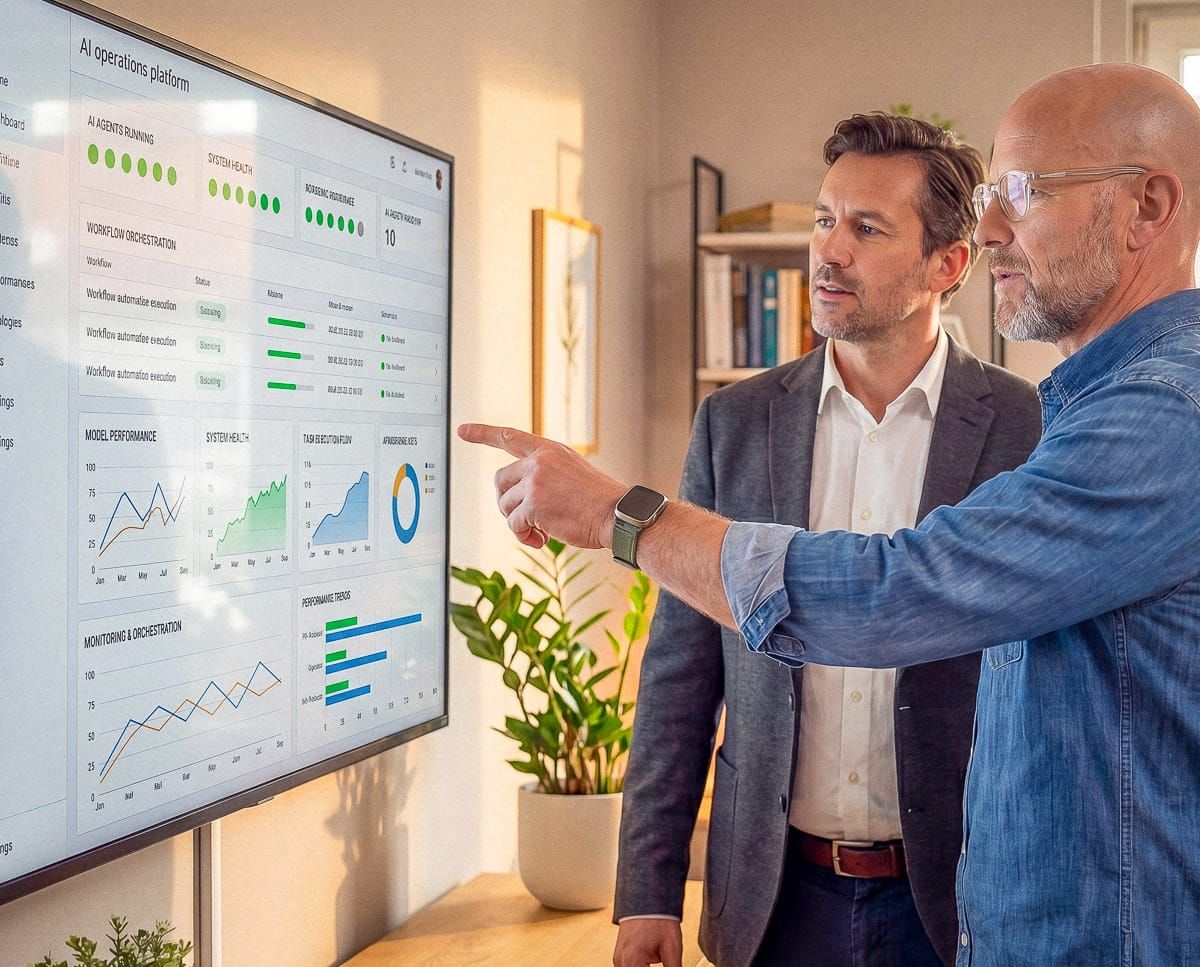
An AI operating layer is the set of automated workflows and live dashboards that handle a company's repetitive operational work – pulling reports, syncing data between tools, surfacing the numbers that decisions depend on – so people spend their hours deciding instead of assembling. I built one into my own company before offering it to anyone: 56 live systems, run by one operator, in about three months. This is what it does, why most companies don't have one yet, and what it's worth in hours back.
Most AI consulting sells you a roadmap. I wanted to know whether the thing actually works before I put a price on it, so I built it on the only company I could break without consequences: my own.
ConversionLab is a one-person operation. There is no ops team to pull the weekly numbers, no analyst to reconcile the bank against the bookkeeping, no junior to chase a stalled outreach thread. For years that meant I did all of it by hand, in the gaps between client work. The reporting alone was an afternoon a week.
So over about three months I rebuilt the company to run on AI. Not a chatbot bolted onto the side – an operating layer underneath everything, wired into the tools I already used. By the end there were 56 live systems running, every build documented across 130 working sessions. That documentation matters more than the count, and I'll come back to why.
What an AI operating layer actually is
The phrase sounds bigger than it is. Strip it down and an AI operating layer does three kinds of work, in order of how hard they are to live without.
It collects. The numbers that run a business already exist – in the analytics tool, the ad platform, the CRM, the bank. They just never sit in one place at the same time. The first job of the layer is to pull it all into a single live view you open in the morning, instead of a deck someone rebuilds by hand every Monday.
Sessions
Conversions
CVR
Bounce rate
Daily sessions (14 days)
Traffic by channel
| Channel | Sessions | Share | Conv. rate |
|---|---|---|---|
| Organic search | 2 614 | 13.1% | |
| Direct | 1 802 | 11.8% | |
| Referral | 993 | 9.2% | |
| 541 | 10.6% | ||
| AI answer engines | 290 | 15.5% |
It watches. Once the data is flowing, the layer can notice things. A metric moving the wrong way, a thread that's gone quiet, a number that crossed a line you set. The work that used to require someone remembering to check now happens on its own and tells you when it needs you.
It acts. The highest layer is the one that handles the repetitive task end-to-end – the briefing that writes itself before you wake up, the report that's finished before the meeting, the routine follow-up that goes out without you queuing it. This is the part that gives you the afternoon back.
If you want to see what this looks like in practice, I included the details – and a way to book a short demo – on my AI operations page.
Most companies that say they "use AI" are stuck at the first rung, and not even all the way up it. They have a tool or two that a few people poke at. What they don't have is the layer underneath that makes the tools talk to each other and run without supervision.
The hard part was never the AI. It was wiring the AI into how a company actually works, day to day, so it runs without me watching it.
Before any of it: the foundation
Here's the part nobody puts in the AI pitch, because it isn't glamorous. Before the first system did anything useful, I spent time on three things that have no output you can demo. They're the reason the 56 systems are consistent, rather than 56 one-off hacks that drift apart.
I defined how everything looks, once. A single brand guide that fixes the color, the type, the buttons, the components – for reports, proposals, dashboards, and landing pages alike. It sounds like a design nicety. It's actually an automation prerequisite. When the look is settled in one place, every system that produces something visible inherits it for free, and I never relitigate a hex code or a heading weight mid-task. The output is on-brand because the brand isn't a decision the system has to make.
One file defines how every surface looks – reports, proposals, dashboards, landing pages. Colour, type, buttons, and components, settled once so nothing gets redecided per task.
Colour palette
Typography · Hanken Grotesk
Buttons
Pill radius reserved for primary and secondary calls to action. First-person, outcome-specific copy.
Components
I built skills for the repetitive work. A skill is a written procedure for a recurring task – how a teardown is structured, how a proposal is priced, how a dashboard page is built. Instead of re-explaining the job every time, the procedure is the input, and the output is the same as last time. This is the difference between an assistant you have to onboard from scratch every morning and one that already knows how your company does things.
I log every session so the work has a memory. Every build gets written down – what changed, why, what's still pending – in a place both I and the AI can read back later. That log is what stops the operating layer from being a black box. Six weeks on, when something needs extending or a system breaks, the reasoning is right there instead of lost.
That last one matters enough to sit on its own.
Why most companies don't have one yet
It isn't cost, and it isn't appetite. Almost every founder and ops lead I talk to knows AI matters and wants to be further along than they are. The gap is that nobody on the team has built this into a working company before, so "we'll get to AI later" keeps slipping. The intent is there; the starting point isn't.
There's also a quieter reason. The companies most able to build their own operating layer – software companies with engineers to spare – are exactly the ones who don't need help doing it. The companies that would benefit most are those with no internal capability to build it: professional firms, service businesses, and lean teams where people are excellent at their actual work and have no reason to be systems integrators as well. For them, the choice isn't build-versus-buy. It's get-it-built or keep doing it by hand.
Why I documented every session
Here's the part that turned a personal project into something I could offer. I logged every build – 130 sessions and counting – not out of nostalgia, but because the documentation is the asset. A system you can't explain, reproduce, or hand over is a liability the day it breaks. A documented system is one you can rebuild, extend, and teach someone else to run.
That discipline is the same one behind my conversion optimization work: don't trust what you can't measure, don't ship what you can't explain, prove it on something real before you scale it. I pointed that discipline toward operations rather than landing pages, and the operating layer emerged.
What it's worth
The honest answer is that it depends on how much manual operational work your company is carrying right now. But the floor is easy to reason about. If one automated reporting pipeline gives a founder or an ops lead a few hours back every week, the system pays for itself on reclaimed time alone – before you count the better decisions that come from finally seeing the numbers in one place every morning.
I built the experiment on myself so that I'd never have to ask a company to take this on faith. The systems are real, they run in production, and you can watch them work before you decide anything.

Want to see what one operator can run with AI? Book a free 20-minute demo. I'll walk you through the systems running my own company live, then we'll pick the three worth building into yours first
That's the whole pitch, and it's not really a pitch. I rebuilt my own company to run on AI, documented every step, and now I build that same operating layer into companies that know it matters but don't have someone who's done it before. You see the proof running first. Then you decide.