A click is worth nothing. Here's what is.
A click costs you money. A conversion makes you money. Why most paid acquisition produces lots of the first and not enough of the second – and what relevancy and timing have to do with it.

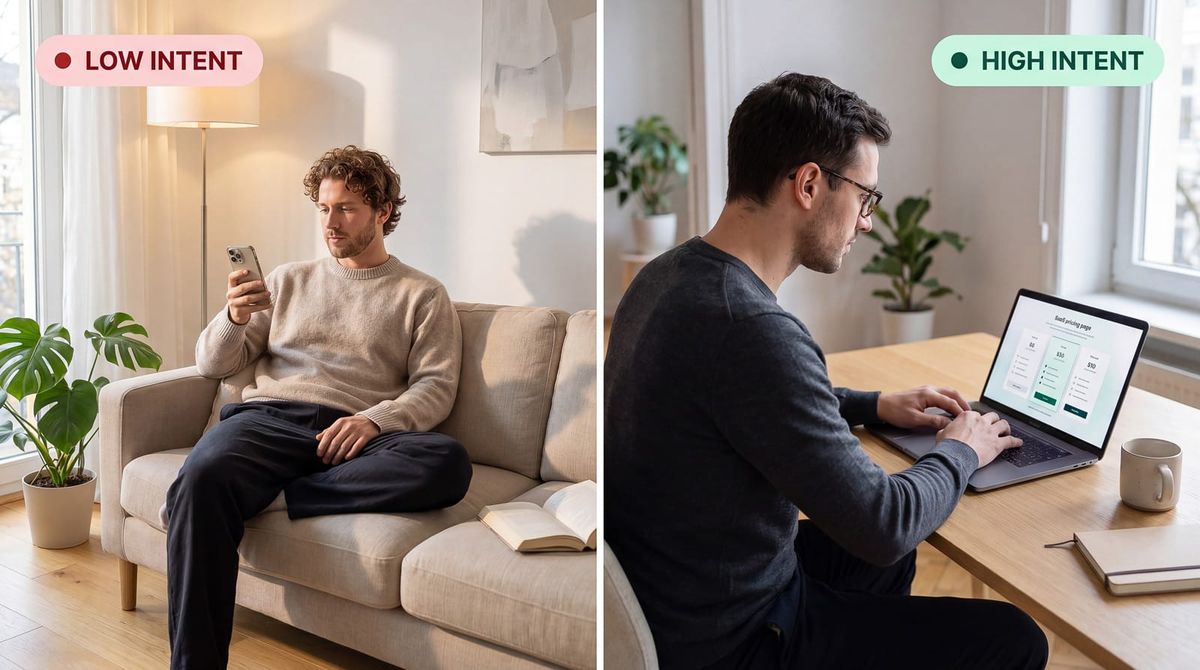
A click costs you money. A conversion makes you money. If your dashboard reports the first without the second, you are optimizing the wrong variable. Traffic source has two parts that decide whether a click turns into a conversion: relevancy, meaning the message matches the person, and timing, meaning they are ready to buy. Most paid acquisition tunes for relevancy, ignores timing, generates more clicks, and converts fewer of them.
If you are still reporting clicks and CTR without conversion rate next to them, you are looking at the wrong number.
You can double your clicks while halving your business. I have watched it happen. Cheaper CPC, sharper creative, tighter targeting, more visitors, and trial signups flat or down. The page did not change. The traffic got worse.
Traffic quality is not how many people click. It is who clicks, and what state they were in when they did.
Relevancy and timing are different things
Relevancy is whether the message matches the person. The visitor works in marketing, the ad is about email marketing, and the page is about email marketing. The audience and the message line up.
Timing is whether the visitor wants what you sell today. Not next quarter. Not when their contract ends. With enough intent to fill in a form or start a trial right now.
A channel can hit one and miss the other completely. That is the trap. Lookalike audiences, job-title targeting, retargeting pixels – they tune for relevancy. They do not tune for timing. And clicks are mostly a function of relevancy, so the sharper your targeting gets, the better your click numbers look, until the conversion data tells you nothing useful is happening.
Relevancy says this person matches your buyer profile. Timing says they are ready to buy. Clicks measure neither.
How each channel scores
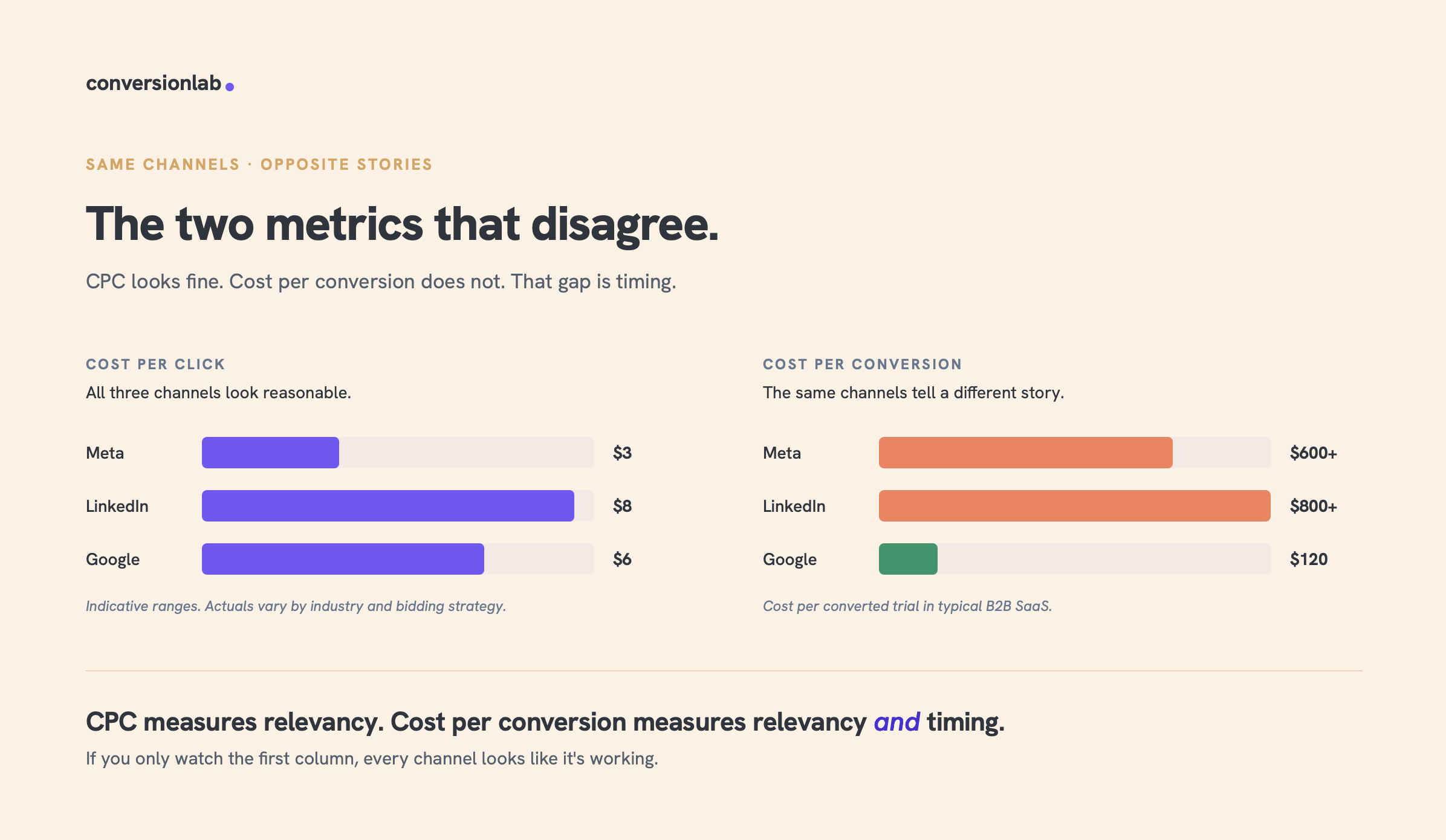
Meta and other paid social. Relevancy is decent if your targeting is sharp. Timing is close to zero. The user opened Instagram to look at friends and dogs. They were not shopping for B2B SaaS. You interrupted them. CPC looks reasonable. Cost per conversion does not.
LinkedIn. Same shape, slightly better on relevancy because the job-title targeting works. Timing is still close to zero unless you have warmed the buyer up first with content or outbound.
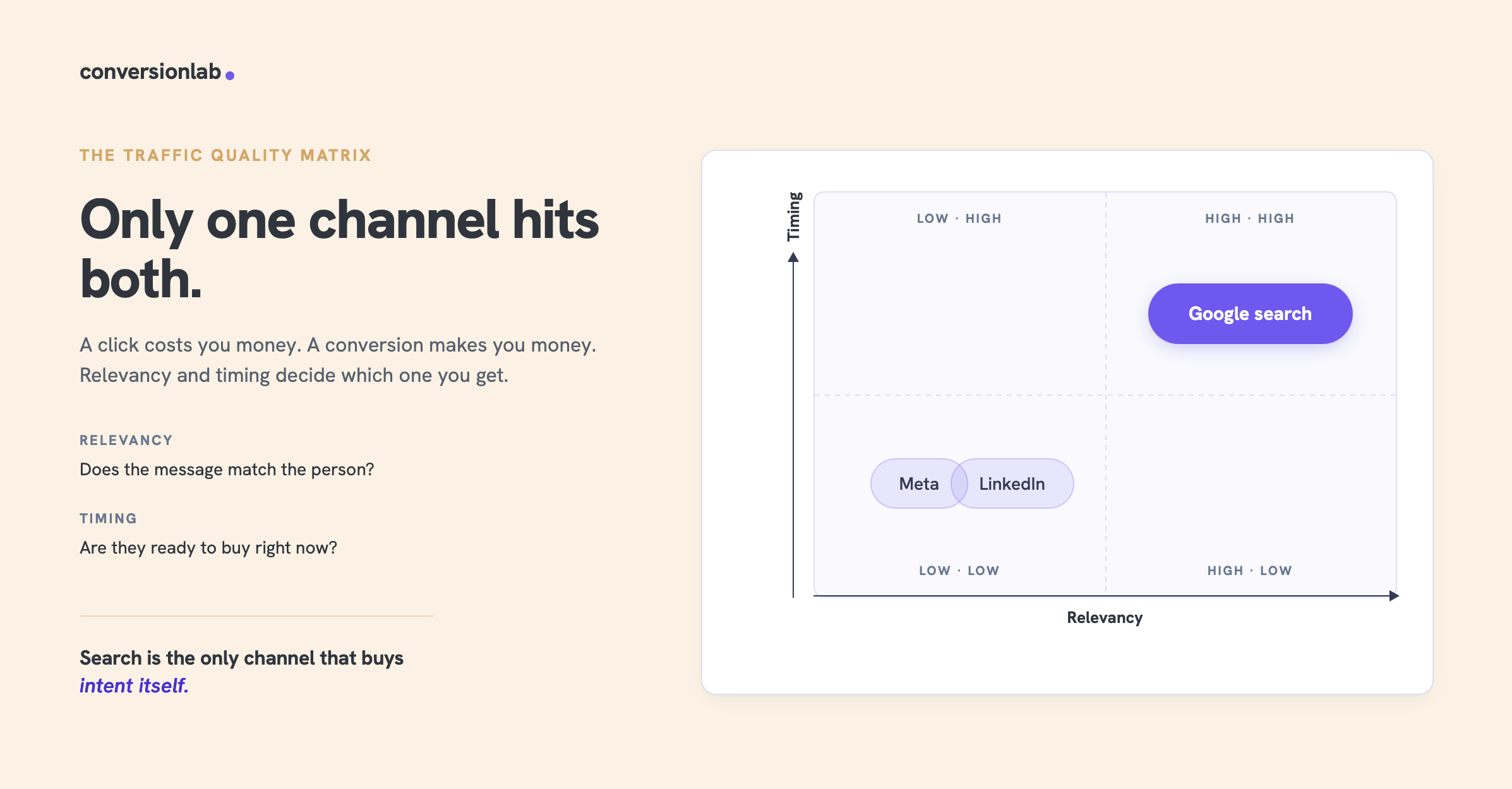
Google search. Relevancy is high when the keyword matches the intent. Timing is also high. Nobody types "best b2b crm for small teams" into Google unless they are in the market. The buyer self-selected into the buying phase before they ever saw your ad. That is why search converts at multiples of what social converts at, even when the social creative is better.
Search hits both. Everything else hits one or neither, and will happily sell you more clicks at low prices for as long as you keep paying.

Why this changes what you should optimize
Start with the dashboard. Clicks and CTR tell you almost nothing without cost per conversion and source-level CVR next to them. If those columns are missing, you cannot tell whether your acquisition is working or just expensive.
Then budget. If cost per conversion on Meta is bad and cost per conversion on Google is good, the answer is rarely "fix the Meta page." Meta is structurally limited by missing timing. Spending more on Meta to compensate buys more of the wrong state. The clicks will look great. The pipeline will not.
Then the page. Search traffic arrives with intent and needs the page to get out of the way. Social traffic arrives without intent and needs the page to build it – more proof, more context, more reason to care before any ask. The same page cannot do both jobs well.
Last, retargeting. If paid social has near-zero timing, the social ad is not there to convert. It is there to put you in front of someone who is not yet ready, so when they are ready, weeks or months later, you are the brand they remember.
"If your paid social is producing lots of clicks and no conversions, you do not have a creative problem. You have a state problem."
What to do instead
When a client tells me paid acquisition is broken, I look at source-level conversion rates first. If Google converts at 4% and Meta converts at 0.3%, the gap is the channel, not the page.
If search traffic is also bad, message match is usually broken. The ad promised one thing, and the page delivered another. That one is fixable.
If social traffic is being asked to start a trial cold, the ask is too big for the state of mind. Lowering it to a guide, a benchmark, or a teardown usually moves the number.
A click is a hand raised. A conversion is a hand on the contract. They are not the same thing, and they should never share a dashboard without context.

Want fresh eyes on your acquisition setup?
I'll look at your landing pages, paid traffic, and where your conversion math is breaking — and map out what to fix first. Free 30-min session, no obligation.